• People
  • Research
  • Projects
  • Publications
  • Resources
ViCoS Lab

MV4.0
Data-driven framework for development of machine vision solutions

applied research project
October 2021 - September 2025

Collaborating partners

  • University of Ljubljana, Faculty of Computer and Information Science
  • Kolektor Mobility Upravljanje naložb d.o.o.

Funding

  • ARIS (L2-3169)

Researchers

Danijel Skočaj, PhD
Danijel Skočaj, PhD
Matej Kristan, PhD
Matej Kristan, PhD
Luka Čehovin Zajc, PhD
Domen Tabernik, PhD
Domen Tabernik, PhD
Matej Dobrevski, PhD
Jon Muhovič, PhD
Jon Muhovič, PhD
Vitjan Zavrtanik, PhD
Matic Fučka, MSc
Matic Fučka, MSc
Blaž Rolih, MSc
Blaž Rolih, MSc
Jer Pelhan, MSc
Jer Pelhan, MSc
Vid Rijavec, BSc
Vid Rijavec, BSc

Scope

MV4.0 addressed one of the main bottlenecks of industrial machine vision: modern deep models usually require large and densely annotated image collections, while such data are expensive to collect in real industrial settings. The project developed a coherent data-driven framework that combines three complementary directions:

  • synthetic data generation from 3D models with automatic annotation,
  • annotation-efficient learning with point supervision, active learning, and few-shot learning,
  • self-supervised and unsupervised modelling for visual anomaly detection.

The developed methods were validated in two main application domains:

  • surface-defect detection and anomaly localisation, including RGB and RGB+3D inspection,
  • object localisation and pose-related perception, including data-efficient localisation and 3DoF pose estimation.

The project was carried out from October 2021 to September 2025 in collaboration with Kolektor Group as the industrial co-funder.

Main results

The project delivered the following main outcomes:

  • a reproducible pipeline for generating synthetic industrial training data from 3D models,
  • new point-supervised, few-shot, and active-learning methods that substantially reduce annotation effort,
  • a strong research line in unsupervised anomaly detection, including DSR, 3DRÆM / 3D anomaly simulation, and TransFusion,
  • validated methods for industrial surface inspection, crack detection, object localisation, and 3DoF pose-related perception,
  • top scientific outputs in venues such as ECCV (DSR, TransFusion), CVPR (DAVE), Pattern Recognition (CeDiRNet), Pattern Recognition Letters (3D anomaly simulation), IEEE RA-L (CeDiRNet-3DoF), and ICPR / Journal of Intelligent Manufacturing (SuperSimpleNet and its extension),
  • a demonstration cell for public and professional presentation of the developed technology.

Realised work packages

WP1, Synthetic data generation and domain adaptation

We developed a reproducible synthetic-data pipeline for industrial scenes using BlenderProc, automatic annotation, and controlled rendering variation. This line was extended towards RGB+3D anomaly scenarios through depth simulation, enabling improved modelling of subtle geometric defects.

WP2, Annotation-efficient learning

We developed methods that reduce the need for dense manual annotation, including:

  • point-supervised centre-direction learning for object counting and localisation,
  • few-shot counting through the DAVE detect-and-verify paradigm,
  • active learning with mixed labels for surface-defect detection,
  • unified supervised and unsupervised defect detection with SuperSimpleNet.

WP3, Self-supervised and unsupervised learning

A major project line focused on anomaly detection without labelled defect samples. This includes:

  • DSR, a dual-subspace re-projection method for surface anomaly detection,
  • 3D anomaly detection methods based on simulated depth anomalies,
  • diffusion-based anomaly detection culminating in TransFusion,
  • studies of robustness to domain shift and training-set contamination.

WP4, Transfer to applications

The developed methods were transferred to the target application domains from the proposal:

  • surface inspection, including 2D and RGB+3D anomaly detection and crack segmentation,
  • object localisation and 3DoF pose-related perception, including industrial parts and grasp-point localisation on deformable objects.

The methods were evaluated on public benchmarks and industrially relevant data in cooperation with Kolektor Group.

WP5, Dissemination and exploitation

The project produced a strong publication record led by papers in ECCV, CVPR, Pattern Recognition, Pattern Recognition Letters, IEEE RA-L, ICPR, and the Journal of Intelligent Manufacturing, complemented by invited talks, award-winning student work, and a modular demonstration cell used for professional and public presentation of the developed methods. Shorter ERK and ROSUS papers mainly served as supporting dissemination of specific application results.

WP6, Project management

The project was completed according to the planned overall logic, from data-generation and unsupervised-learning foundations to annotation-efficient learning, application studies, dissemination, and demonstrator integration.

Software, datasets, and related resources

Project-related software and datasets:
 
3DSR

Official implementation of 3DSR / 3DRÆM-style depth-simulation-based methods for 3D anomaly detection used in the WACV 2024, Pattern Recognition Letters 2024, and related MV4.0 outputs.

 
CeDiRNet

PyTorch implementation of Center Direction Regression Network for object counting and localization with point supervision from Pattern Recognition 2024 paper.

 
CeDiRNet-3DoF

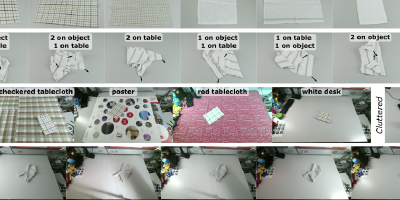
PyTorch implementation of Center Direction Regression Network for Grasping Point Localization on Cloths from IEEE Robotics and Automation Letters 2024 paper.

 
DAVE

Official implementation of DAVE, a detect-and-verify paradigm for low-shot counting from the CVPR 2024 paper.

 
DSR

Official implementation of DSR, a dual subspace re-projection network for surface anomaly detection from the ECCV 2022 paper.

 
SegDec-Net++

Implementation for automated crack detection and segmentation in concrete surfaces from the Construction and Building Materials 2023 paper.

 
SuperSimpleNet

PyTorch implementation of SuperSimpleNet for fast and reliable surface defect detection across unsupervised and supervised settings.

 
TransFusion

Official PyTorch implementation of TransFusion, a transparency-based diffusion model for anomaly detection from the ECCV 2024 paper.

 
ViCoS Cube

Modular application code for the ViCoS demonstration cell, together with links to the associated ROSUS 2024 paper.

 
ViCoS Towel Dataset

Dataset for benchmarking robot cloth grasping models on 3DoF task.

 
Mixed SegDec-Net

PyTorch implementation of SegDec-Net using weakly, mixed and fully supervised learning for surface defect detection. Implementation from ICPR2020 and COMIND2021 papers.

 
Kolektor Surface-Defect Dataset 2 (KolektorSDD2 / KSDD2)

Dataset for defect-detection in industrial surfaces

Related research overviews:

  • Anomaly detection research
  • Few-shot counting research
  • Vision for manipulation

Publications

  •  
    A Detect-and-Verify Paradigm for Low-Shot Counting - DAVE
    Jer Pelhan, Alan Lukežič, Vitjan Zavrtanik and Matej Kristan
    IEEE / CVF Computer Vision and Pattern Recognition Conference (CVPR), 2024
  •  
    Aktivno učenje z mešanimi oznakami za detekcijo površinskih napak z globokimi nevronskimi mrežami
    Domen Tabernik and Danijel Skočaj
    ERK, 2024
  •  
    Center Direction Network for Grasping Point Localization on Cloths
    Domen Tabernik, Jon Muhovič, Matej Urbas and Danijel Skočaj
    IEEE Robotics and Automation Letters, IEEE, 2024
  •  
    Cheating Depth: Enhancing 3D Surface Anomaly Detection via Depth Simulation
    Vitjan Zavrtanik, Matej Kristan and Danijel Skočaj
    WACV 2024, 2024
  •  
    Demonstracijska celica za prikaz globokega učenja v praktičnih aplikacijah
    Domen Tabernik, Peter Mlakar, Jakob Božič, Luka Čehovin Zajc, Vid Rijavec and Danijel Skočaj
    ROSUS 2024 - Računalniška obdelava slik in njena uporaba v Sloveniji 2024, 2024
  •  
    Dense Center-Direction Regression for Object Counting and Localization with Point Supervision
    Domen Tabernik, Jon Muhovič and Danijel Skočaj
    Pattern Recognition, 2024
  •  
    Keep DRÆMing: Discriminative 3D anomaly detection through anomaly simulation
    Vitjan Zavrtanik, Matej Kristan and Danijel Skočaj
    Pattern Recognition Letters, 2024
  •  
    SuperSimpleNet: Unifying Unsupervised and Supervised Learning for Fast and Reliable Surface Defect Detection
    Blaž Rolih, Matic Fučka and Danijel Skočaj
    Pattern Recognition: 27th International Conference, ICPR 2024, Springer, 2024
  •  
    TransFusion - A Transparency-Based Diffusion Model for Anomaly Detection
    Matic Fučka, Vitjan Zavrtanik and Danijel Skočaj
    European Conference on Computer Vision (ECCV), 2024
  •  
    3D-model-based Rendering of Synthetic Images For Training Segmentation Models in an Industrial Environment
    Matic Fučka, Marko Rus, Jakob Božič and Danijel Skočaj
    ROSUS 2023 - Računalniška obdelava slik in njena uporaba v Sloveniji 2023, 2023
  •  
    Automated detection and segmentation of cracks in concrete surfaces using joined segmentation and classification deep neural network
    Domen Tabernik, Matic Šuc and Danijel Skočaj
    Construction and Building Materials, 2023
  •  
    Diskriminativna metoda za detekcijo 3D anomalij
    Vitjan Zavrtanik, Matej Kristan and Danijel Skočaj
    ERK, 2023
  •  
    Lokalizacija in ocenjevanje lege predmeta v treh prostostnih stopnjah s središčnimi smernimi vektorji
    Domen Tabernik, Jon Muhovič and Danijel Skočaj
    ERK, 2023
  •  
    DSR – A Dual Subspace Re-Projection Network for Surface Anomaly Detection
    Vitjan Zavrtanik, Matej Kristan and Danijel Skočaj
    ECCV 2022, 2022

Funding

MV4.0 was funded by ARIS and co-funded by Kolektor Mobility Upravljanje naložb d.o.o.

arrs

Faculty of Computer and Information Science

Visual Cognitive Systems Laboratory

University of Ljubljana

Faculty of Computer and Information Science

Večna pot 113
SI-1000 Ljubljana
Slovenia
Tel.: +386 1 479 8245